
ONE GOD AFRICA · KINGDOM WISDOM
The Confident Fool and the Silent Genius
The Four Faces of Competence at the Crossroads of Growth
1. Introduction: My Walk With These Four Faces
On my walk through life - from the schoolyard in Cape Town, to soccer fields in the flats, to boardrooms, braais, and church gatherings - I’ve come across four kinds of people. Some of them stood out with loud voices, boldness, and charisma, but when you dug deeper, they carried very little substance. Some stayed in the background, overlooked, quiet, yet they carried deep skill and wisdom, waiting for the right moment to shine. Others seemed lost - unsure of themselves, their strengths, or their path. And then, every now and then, I encountered those rare few who carried both skill and confidence, walking in balance, inspiring others.
We’ve all met these people. And if we are honest, at different times in our lives, we have been these people.
At a braai in Goodwood, you’ll see the confident fool - the one who cracks the jokes, dominates the conversation, wins the room. But give them a spreadsheet, ask them to run a strategy session, or put them under real pressure, and they crumble.
On the soccer fields in Heideveld or Gugulethu, you’ll spot the silent genius - the boy who sees the game two steps ahead of everyone else, whose passes slice through defenders, whose instinct is sharp. Yet outside the pitch, he shrinks into himself, convinced his gift is small, unseen, or undeserving.
In classrooms, you’ll meet the dormant face - children still figuring out who they are, what their gifts are, and where they belong. They aren’t failures; they’re seedlings.
And in rare moments, you’ll encounter the complete face - the one who has both competence and confidence. They walk tall, they speak truth, and they deliver. They’re Siya Kolisi leading the Springboks. They’re leaders who inspire, not just perform.
This teaching is about helping you see these four faces. Not just in others, but in yourself. And then learning how to grow, step by step, from where you are to where God is calling you.
The Framework: Competence + Confidence
To understand the four faces, we need two simple measures:\
1. Competence → what you can do (skills, knowledge, abilities).
2. Confidence → how you carry it (belief, courage, presence, self-worth).
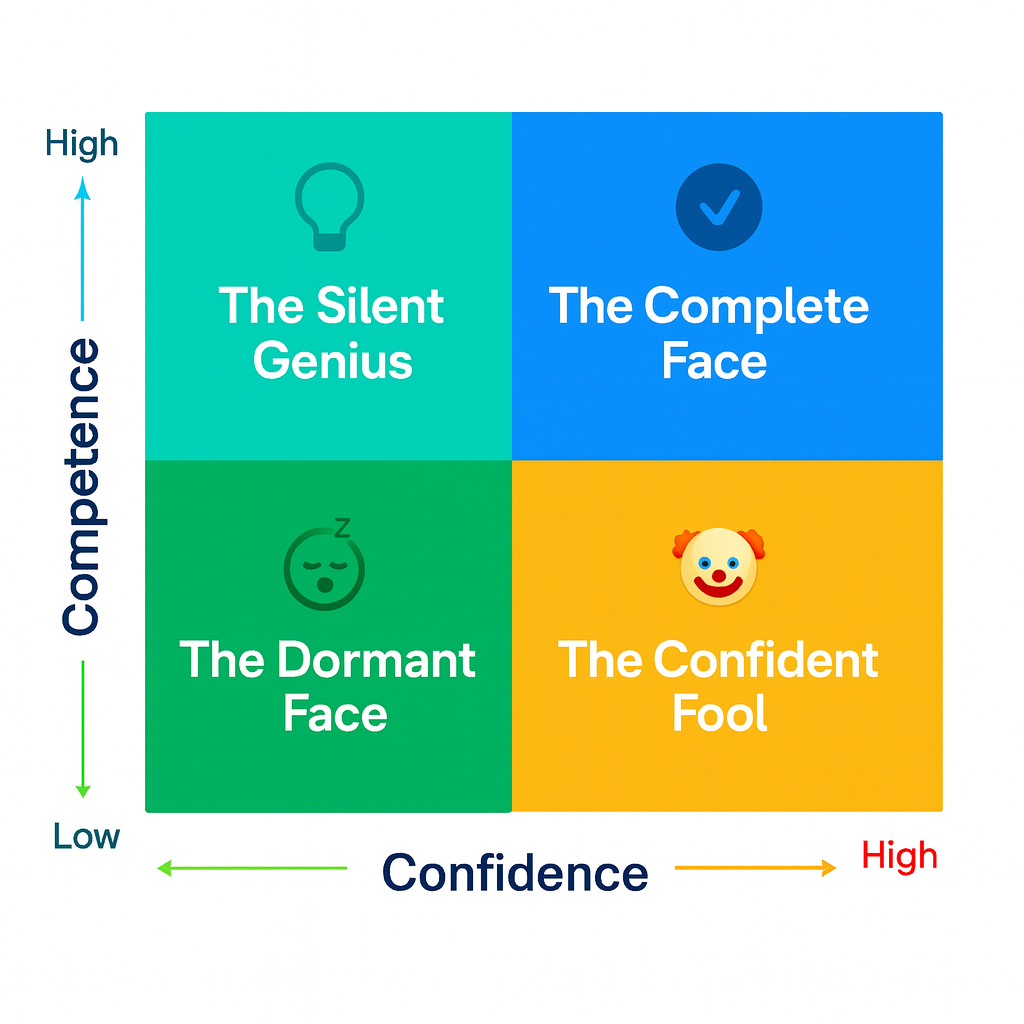
Cross them together, and you get four quadrants - four faces:
1. Low Competence, Low Confidence → The Dormant Face.
2. Low Competence, High Confidence → The Confident Fool.
3. High Competence, Low Confidence → The Silent Genius.
4. High Competence, High Confidence → The Complete Face.
None of these are permanent. You can move between them, sometimes in one season, sometimes even in one week. Environment, failure, success, hardship, and grace all shift us. And God uses each stage to grow us.
2. The Confident Fool - Low Competence, High Confidence
The confident fool is one of the easiest faces to spot. You don’t have to look far. You’ll find him at the braai in Goodwood, beer in hand, standing tall, pulling everyone’s attention with jokes and loud stories. He knows how to own a room. He’s charming, he’s magnetic, and for that moment, everyone thinks, This guy’s got it all together. But give him something heavy - a spreadsheet, a strategy session, a real crisis - and suddenly the voice that filled the night before goes quiet. His confidence shines bright in easy spaces, but when the test comes, it crumbles.
I’ve seen this face too many times in different settings. In the workplace, it’s the colleague who’s quick to put their hand up, eager to impress the boss, promising deadlines they can’t meet. They know how to speak the language of success, but behind the talk, there’s no depth, no preparation, no delivery. It’s like watching a balloon filled with hot air - it floats high at first, but one small prick and it collapses flat.
In friendships, the confident fool is the guy who says, “Don’t worry, I’ve got you.” He promises he’ll pull through when you need him, he swears he’ll arrive early, he assures you he’ll sort things out. But when the day comes, his phone is off, or there’s an excuse waiting on his tongue. Words are cheap currency for the confident fool, and he spends them freely, without the weight to back them up.
And yes, I’ve seen it in the church too. There are people who can preach fire, who can make the congregation stand up and shout “Amen!” with passion. Their prayers are loud, their words dripping with confidence, and people walk away moved - but only for a moment. Because when you look at their daily life, there’s no fruit. The same voice that called fire from heaven on Sunday is missing when temptation knocks on Monday. The confident fool can stir emotions, but without discipline, without grounding in God, it all fades away.
Here’s the truth: confidence on its own is not evil. God made us to walk with boldness. The problem is when confidence outpaces competence. When you speak more than you can live. When your words build castles your hands can’t defend. That’s when it becomes dangerous - not just for you, but for those who follow you.
The Bible shows us this face clearly in Peter. He was the loudest of the disciples. Always the first to speak, the first to jump, the first to act. When Jesus warned that the disciples would scatter, Peter stood up straight and said:
“Even if all fall away on account of you, I never will.” (Matthew 26:33)
That’s classic confident fool energy. Bold, certain, ready to make promises bigger than his ability. And just hours later, Peter was in the courtyard, confronted by a servant girl, and the same bold voice cracked:
“Then he began to call down curses, and he swore to them, ‘I don’t know the man!’ Immediately a rooster crowed.” (Matthew 26:74)
From “I will never leave you” to “I don’t know Him” in the same night. That’s the confident fool in action - words running far ahead of strength.
Now, here’s where God’s grace blows my mind. Because if it was us, we’d write Peter off. We’d say, “This guy is unreliable. He talks too much. Can’t be trusted.” But Jesus didn’t discard him. He restored him. And after Pentecost, filled with the Spirit, Peter’s confidence and competence finally aligned. The same man who once buckled under the pressure of a servant girl now stood before thousands in Jerusalem and preached boldly, leading three thousand souls to Christ in a single day. (Acts 2:14 - 41)
That’s the hope I see in the confident fool. They are frustrating, they can be dangerous, but they are not beyond redemption. The same loud voice that once misled can, in God’s hands, become a voice that leads nations.
But let me be real with you - being a confident fool comes with consequences. You hurt people when you overpromise. You lose trust when you underdeliver. You leave trails of disappointment behind you. Followers who thought you were strong realize you were hollow. Family who counted on you feels betrayed. Friends stop believing your words. The confident fool doesn’t just fall alone; they often take others down with them.
And many times, God allows a fall to expose the gap. The rooster crow moment. Maybe it’s a failed business deal. Maybe it’s being embarrassed at work because you weren’t prepared. Maybe it’s a relationship breaking because you kept promising what you couldn’t give. These moments hurt deeply. They strip you of pride. They make you question yourself. But they are also the soil where God can finally grow something real.
Because here’s the shift the confident fool has to make: from hype to humility, from talk to truth, from self-confidence to God-confidence.
When you recognize you’re wearing this face, the answer isn’t to shrink back and kill your confidence. It’s to let God reshape it. To say, “Lord, let my boldness be matched with Your wisdom. Let my words be backed by discipline. Let my promises be smaller but my delivery be stronger.”
I’ve had to face this in my own life too. Times where I spoke too quickly, said yes too easily, acted like I had more capacity than I really did. And the fallout taught me: empty confidence breaks more than silence ever could. It’s better to speak less and deliver more than to impress and fail.
But don’t miss this: the confident fool is not stuck forever. In fact, some of the strongest leaders you’ll meet were once confident fools. They had to be humbled, stripped down, broken, and then rebuilt. And when confidence and competence finally align, they become powerful. Think of Peter. Think of leaders who learned through failure. Think of people who once stumbled loudly but now stand firm.
So if you see this face in yourself - don’t despair. Recognize it. Repent of it. Ask God to humble you. And then commit to doing the work: study, prepare, show up, follow through. Let your confidence rest not in charm, but in Christ.
Because in the end, the confident fool’s greatest danger is also their greatest gift. They already have the courage to speak. They already have the presence to influence. All that’s missing is the depth to carry it. And when God adds that depth, that’s when the fool becomes complete.
3. The Silent Genius - High Competence, Low Confidence
The silent genius is harder to spot than the confident fool, but once you’ve seen them, you’ll never forget them. They don’t grab the mic. They don’t stand in the spotlight. They’re the ones in the corner, watching, noticing, carrying gifts that nobody else sees. And yet, when the moment comes, when the ball is at their feet or the problem is in their hands, they reveal brilliance that shocks everyone.
I grew up seeing silent geniuses everywhere. On the soccer fields in Heideveld or Gugulethu, there was always that one boy who never shouted for the ball, never argued with the coach, never tried to be flashy. He would just stand quietly, almost invisible. But when the game kicked off, his passes cut defenders apart like a knife. He saw spaces nobody else could see. He thought three moves ahead. His gift wasn’t noise, it was vision. And yet, too often, that boy would leave the field, shrink back into the shadows, convinced his talent didn’t matter. He’d never go to trials, never push for opportunities. His gift would die quietly, because he lacked confidence to carry it.
The workplace is filled with silent geniuses too. I’ve sat in boardrooms where one analyst, buried under layers of hierarchy, had the answer that could save millions. Their report had it all - the detail, the insight, the breakthrough. But when the meeting came, they stayed silent while louder voices filled the space. They saved the company quietly but never got the recognition, never stepped into the authority their competence deserved.
The danger of the silent genius is not failure - it’s waste. They have the skill, the knowledge, the ability, but without confidence, their gift never leaves the shadows. Society misses out. Families miss out. The Kingdom misses out.
The Bible paints this face beautifully in David’s story. When Samuel came to anoint a new king, Jesse lined up all his impressive sons. Strong, tall, confident. But the Lord rejected each one, saying:
“Do not consider his appearance or his height, for I have rejected him. The Lord does not look at the things people look at. People look at the outward appearance, but the Lord looks at the heart.” (1 Samuel 16:7)
David wasn’t even invited to the lineup. His own father overlooked him. He was out in the fields with the sheep - hidden, unseen, silent. But in that hidden place, competence was growing. He fought lions and bears when nobody was watching. He wrote psalms under the stars. He learned courage in the shadows.
When the battlefield moment came - when Goliath stood taunting Israel - David stepped out of silence. He didn’t need armor, he didn’t need loud speeches. He had competence from the secret place, and he had confidence rooted in God.
“David said to the Philistine, ‘You come against me with sword and spear and javelin, but I come against you in the name of the Lord Almighty.’” (1 Samuel 17:45)
The silent genius became the giant slayer.
But here’s the reality: not every silent genius gets their Goliath moment. Many live their entire lives hidden, waiting for permission that never comes. And that’s why mentorship and encouragement are so crucial. Silent geniuses often don’t know how gifted they are. They underestimate themselves. They doubt their worth. They need someone to say, “You have something in you - don’t hide it.”
I think of young people in Cape Town who are brilliant with numbers, design, or leadership, but because of where they grew up, or because no one believed in them, they stay quiet. I think of mothers who run homes with wisdom that could transform businesses, but they call themselves “just a mom.” I think of young men who hear from God but are too shy to speak it out, afraid of judgment. The silent genius is everywhere, hiding in plain sight.
And let me be honest - many of us have worn this face. We know we have something to offer, but fear keeps us down. We shrink back in meetings. We let others take credit. We convince ourselves we’re not ready, not worthy, not enough. Meanwhile, God is saying, “I put that gift in you for a reason. Don’t bury it.”
Jesus told a parable about servants given talents. One buried his talent in the ground because he was afraid. He kept it safe, unused. That’s the silent genius -competent, but too scared to let the gift out. And the Master’s response was sharp:
“You wicked, lazy servant!” (Matthew 25:26)
It wasn’t the lack of gift that angered the Master - it was the refusal to use it.
Silent geniuses need courage. They need moments that push them out of the shadows. Sometimes it’s crisis - like Esther, quiet in the palace until Mordecai told her, “Who knows but that you have come to your royal position for such a time as this?” (Esther 4:14). Sometimes it’s encouragement - like Barnabas, whose name means “son of encouragement,” taking Paul under his wing and vouching for him when others doubted.
And sometimes, it’s just raw faith - choosing to step forward even when fear screams. Confidence doesn’t always come first. Sometimes it grows as you move.
The tragedy is when a silent genius never steps out. When their competence stays hidden, their voice unheard, their gift unused. How many businesses, ministries, communities, and families are weaker today because a silent genius kept quiet?
But here’s the hope: God sees what others overlook. He saw David in the fields. He saw Gideon hiding in the winepress, calling him a “mighty warrior” before Gideon believed it. He saw Mary, a young girl in Nazareth, and trusted her with carrying the Savior of the world.
If you’ve been wearing the face of the silent genius, know this: your silence is not your destiny. Your gift was not meant to stay buried. Your competence is not a mistake. The Kingdom needs it. Your community needs it. And God is calling you to step forward, even if your voice shakes.
Confidence may feel unnatural at first. You may stumble, you may sweat, you may want to run. But as David said, “I come in the name of the Lord.” Confidence rooted in God is not arrogance - it’s alignment. It’s saying, “This gift is not mine, it’s His. And I will use it.”
So here’s my challenge: if you see yourself as the silent genius, don’t wait for the perfect moment. Don’t wait for someone to hand you a microphone. Start small. Speak up once in the meeting. Share your idea with a friend. Sing the song. Write the post. Lead the prayer. Take the step. Because competence without confidence is wasted potential. And the world cannot afford to miss what God placed inside you.
4. The Dormant Face - Low Competence, Low Confidence
The dormant face is often misunderstood. When we see someone who’s quiet, unsure of themselves, not shining in any obvious way, we’re quick to write them off as lazy, weak, or without potential. But dormancy is not death. It’s preparation. Every tree starts as a seed, hidden under the soil, unseen, while roots take shape. Every fire begins as a spark. And every person who has ever stood tall once walked through seasons of small beginnings.
I think of school days in Cape Town. There were always those kids who didn’t stand out. They weren’t the top of the class. They weren’t the stars on the sports field. They were just… there. Sitting quietly at the back, unsure of themselves, trying to figure out who they were. At the time, nobody noticed them. Teachers focused on the loud ones, the achievers, the troublemakers. But give it a few years, and you’d be surprised. Some of those same “ordinary” kids grew into doctors, engineers, pastors, parents who raised whole families with strength. They weren’t failures - they were seedlings in their dormant stage.
I’ve seen dormancy in adults too. A young graduate stepping into their first job, overwhelmed, unsure of how to carry themselves. A man retrenched after years in one industry, starting fresh somewhere else. A mother who put her dreams on hold to raise her kids, and now feels out of place stepping back into work. Dormancy doesn’t just happen at the start of life - it can happen in new seasons, new roles, new places.
And in the Kingdom, dormancy is everywhere. New believers who love God but don’t yet know how to read the Word deeply, how to pray with power, how to serve with consistency. They’re still drinking “spiritual milk,” as Paul puts it, not ready yet for “solid food” (Hebrews 5:12 - 14). And that’s okay. Because growth takes time.
Paul reminded Timothy of this when he was young and stepping into leadership. He told him:
“Don’t let anyone look down on you because you are young, but set an example for the believers in speech, in conduct, in love, in faith and in purity.” (1 Timothy 4:12)
Dormancy is not uselessness. It’s development.
But let’s be honest: dormancy feels hard when you’re the one in it. It feels like obscurity. You watch others shine while you’re still figuring yourself out. You scroll through social media and see friends with businesses, ministries, families, platforms, while you’re still in the shadows. It’s tempting to believe you’ve been left behind.
Yet, in God’s economy, hiddenness is holy. Joseph was dormant as a dreamer in his father’s house before Egypt tested him. Moses spent forty years in the desert tending sheep before leading Israel out of bondage. Even Jesus lived thirty hidden years in Nazareth before stepping into three years of ministry. Dormancy is not wasted time - it’s God’s workshop.
I’ve seen people despise their dormancy. They rush ahead, trying to prove themselves too soon. They crave recognition, so they overreach. But when competence and confidence aren’t ready, the weight of responsibility crushes them. It’s like picking fruit too early -it looks good on the outside, but inside it’s sour. Dormancy protects us from that.
And yet, dormancy is not a license to do nothing. Seeds in the ground are still alive, still growing. They’re developing roots strong enough to hold a tree. So if you’re in a dormant season, your job is not to wait passively - it’s to grow quietly. To study. To pray. To prepare. To let your roots sink deep in God before the storm comes.
The danger of staying dormant too long is that fear can settle in. Comfort becomes a cage. You convince yourself you’re not ready, not called, not enough. And before you know it, years have passed. Dormancy has turned into stagnation. That’s when mentorship matters. That’s when encouragement becomes oxygen. Someone needs to come alongside you and say, “Don’t despise small beginnings. What you’re doing now matters. Keep going. Growth is coming.”
I’ve seen this in Cape Flats classrooms. A child who seems slow to learn, struggling at first, but with a teacher’s patience, begins to blossom. One small breakthrough in reading, one word of encouragement, and suddenly the child’s whole face changes. They realize they’re not stupid, they’re just learning. And once confidence kicks in, competence follows.
The Bible shows us God’s patience with dormancy again and again. Look at Gideon. When the angel of the Lord found him, he was hiding in a winepress, threshing wheat in fear. He didn’t see himself as a warrior. He was dormant, small, unsure. Yet God called him “Mighty Warrior” before Gideon ever picked up a sword (Judges 6:12). That’s how God sees dormant faces - not as failures, but as futures waiting to unfold.
So if you feel like you’re in the dormant quadrant, don’t rush to escape it, but don’t settle there either. Let it shape you. Let it teach you patience. Let it drive your roots deep in God. Then, when the season shifts, you’ll be ready to carry fruit without breaking.
Dormancy is not glamorous. It’s not Instagram-worthy. It doesn’t get applause. But it’s sacred. And when God breathes on a dormant seed, it breaks open, it sprouts, and it becomes something no one expected.
So don’t despise your hidden season. Don’t compare your chapter one to someone else’s chapter twenty. Dormancy is God’s way of protecting your gift until it’s strong enough to carry the weight of your calling.
5. The Complete Face - High Competence, High Confidence
The complete face is rare. It’s that balance point where competence and confidence finally align. Most of us live swinging between the other three - fumbling in dormancy, hiding as silent geniuses, stumbling as confident fools. But every now and then, you meet someone who carries both depth and presence. They know what they’re doing, and they know how to walk in it. And when they step into a room, they don’t just perform - they inspire.
I’ve seen glimpses of this face in leaders across different spaces. On the rugby field, Siya Kolisi comes to mind. Competence: his skill, fitness, strategy, discipline. Confidence: the way he stands before a nation, steady and humble, speaking not just as a player but as a leader. That’s why people follow him. Not just because he can tackle or score, but because he carries both competence and confidence in balance.
I’ve also seen it closer to home - a father who provides for his family, not only financially but emotionally and spiritually. He knows his role, and he walks in it with quiet strength. Or the colleague who doesn’t shout in meetings, doesn’t dominate, but when they speak, the room listens because their words are sharp, their presence steady.
This face is not about being perfect. It’s about being whole. It’s the fruit of the journey through the other quadrants. You don’t become complete overnight. You pass through seasons of silence, you fall as a fool, you grow through dormancy. And in time, those lessons carve you into someone who can carry both skill and spirit.
The Bible shows us this face most clearly in Jesus. At age thirty, He steps into public ministry after thirty hidden years in Nazareth. And immediately, people notice something different:
“The people were amazed at his teaching, because he taught them as one who had authority, not as the teachers of the law.” (Mark 1:22)
Authority. Not just knowledge, not just confidence - both together. His wisdom was unmatched, His miracles undeniable, and His courage unshakable. Competence and confidence, fully complete.
And yet, Jesus didn’t carry this face with pride. He carried it with humility. That’s the secret of the complete face. It doesn’t shout, “Look at me.” It says, “Follow me as I follow the Father.”
Think of Paul too. By the time he was writing to the churches, his competence was rooted in years of study, prayer, suffering, and service. His confidence was unshakable, even in prison. “I can do all things through Christ who strengthens me” (Philippians 4:13). That’s the voice of someone complete - not arrogant, not timid, but steady.
But let’s be real - the complete face is not a permanent state. You don’t reach it and stay there forever. Life has a way of testing you, knocking you back into doubt, pushing you through silence, humbling your overconfidence. Being complete is about cycles. You may be complete in one season, then face a new challenge that throws you back into dormancy. That’s okay. Each time you circle back, you carry a deeper completeness than before.
I think of leaders I’ve watched in Cape Town. Some carried the complete face for a while -they built businesses, raised families, led communities with grace. But when pride crept in, or when new challenges came, they stumbled. And that’s the test: the complete face is not a trophy, it’s a responsibility. The more you carry, the more humility you need.
And that’s the danger - pride at the mountain tops. The Bible warns us:
“Pride goes before destruction, a haughty spirit before a fall.” (Proverbs 16:18)
At the peak, when competence and confidence feel unshakable, pride whispers, “You did this on your own.” That’s when the complete face can slip back into the fool. Which is why anchoring in God is non-negotiable. Without Him, completeness collapses into arrogance.
But when rooted in God, the complete face changes everything. Families are steadied. Businesses grow with integrity. Communities are uplifted. Nations are inspired. Because the world is desperate for leaders who are not just loud, not just skilled, but whole.
I’ve seen glimpses of this in ordinary spaces too. A teacher in Mitchells Plain who not only knows her subject but believes in her learners, lifting them higher. A young entrepreneur in Khayelitsha who not only has the business plan but has the courage to pitch it, employ others, and reinvest in his community. A pastor in Athlone who preaches the Word faithfully but also lives it out in his home. These are complete faces in action.
And here’s what makes them powerful: they multiply. The complete face doesn’t hoard their gift. They invest in others. They mentor. They encourage. They build. Because true completeness isn’t about standing alone - it’s about raising others to completeness too.
So if you find yourself in this quadrant, the question is: what will you do with it? Will you use it to build your own empire, or will you pour it out to build the Kingdom? Will you shine for yourself, or will you point others to God?
Completeness is not the end of the journey. It’s the point where your journey starts to transform others.
6. The Growth Cycle: Moving Between Faces
The truth about these four faces is this: none of us stay in one forever. Life shifts us. Circumstances humble us. Opportunities stretch us. Success tempts us. Failure teaches us.
God, in His wisdom, uses every face to shape us.
- The silent genius will eventually be forced into the open. Someone will call on them, a crisis will demand their gift, or life will throw them into a battle they cannot avoid. That’s when competence gets tested, and confidence must rise.
- The confident fool eventually faces exposure. Sooner or later, when words and hype can’t save them, reality strips them. That’s when humility must be embraced, and competence must be built.
- The dormant slowly grows. Time, mentorship, exposure, and testing develop them into something greater.
- The complete face is never static either. New challenges push them back into doubt, forcing them to relearn, grow, and become complete at a new level.
7. Rock Bottoms and Mountain Peaks
The journey between these faces is often marked by two extreme moments: rock bottoms and mountain peaks.
1. Rock bottoms are when life knocks you down so hard, you feel stripped of both competence and confidence. Maybe you lost your job. Maybe your marriage failed. Maybe you made a mistake that cost you dearly. At rock bottom, you feel like a beginner again - unsure of your worth, unsure of your ability. But rock bottoms are often God’s soil for new growth.
2. Mountain peaks are the opposite - those moments when you feel unstoppable, invincible, on top of the world. But mountains have edges. Pride often blinds us at mountain peaks, and we overstep.
The Bible warns:
“Pride goes before destruction, a haughty spirit before a fall.” (Proverbs 16:18)
This cycle isn’t punishment - it’s process. God uses it to prepare us.
8. The Story of Joseph: A Walk Through All Four Faces
Joseph’s life is the clearest example of moving through these faces.
Dormant Face: The Young Dreamer
Joseph grew up as the favored son of Jacob, wearing the famous “coat of many colors.” He had dreams - big dreams of ruling, of his brothers bowing to him.
“Joseph had a dream, and when he told it to his brothers, they hated him all the more.” (Genesis 37:5)
At this stage, Joseph was dormant. He had potential, but he didn’t yet know how to steward it. He spoke too quickly, lacked wisdom, and provoked jealousy.
The Confident Fool: Speaking Too Soon
Joseph shared his dreams without wisdom, boasting in a way that made his brothers furious.
“Listen to this dream I had: We were binding sheaves of grain out in the field when suddenly my sheaf rose and stood upright, while your sheaves gathered around mine and bowed down to it.” (Genesis 37:6 - 7)
He was confident, but not yet competent in leadership. His words outpaced his maturity. His brothers threw him into a pit and sold him into slavery.
The Silent Genius: Serving in Shadows
As a slave in Egypt, Joseph proved himself. In Potiphar’s house, he quietly managed everything with excellence. When falsely accused and thrown into prison, he didn’t complain. Instead, he interpreted dreams for fellow prisoners.
“The Lord was with Joseph so that he prospered, and he lived in the house of his Egyptian master.” (Genesis 39:2)
Here, Joseph was a silent genius. Competent, but unseen. Gifted, but overlooked. Faithful in the shadows.
The Complete Face: Standing Before Pharaoh
Finally, Joseph was called before Pharaoh to interpret a troubling dream. He not only interpreted it but gave Pharaoh a 14-year national strategy to survive famine.
“Then Pharaoh said to Joseph, ‘Since God has made all this known to you, there is no one so discerning and wise as you. You shall be in charge of my palace, and all my people are to submit to your orders.’” (Genesis 41:39 - 40)
Joseph became the complete face - competence and confidence together. His journey through the other faces prepared him for this moment.
9. Practical Steps: Growing Into Your Next Face
God doesn’t want you stuck in one face. He wants you moving, learning, and maturing. Here’s how:
Step 1: Identify Your Face Honestly
Ask: Where am I today? Am I loud with no depth? Gifted but silent? Dormant, still forming? Or complete at my current level? Self-awareness is the start of growth.
“Examine yourselves to see whether you are in the faith; test yourselves.” (2 Corinthians 13:5)
Step 2: Seek Feedback and Mentorship
-** **Silent geniuses need someone to say, “You are gifted - step out.”
- *Confident fools need someone bold enough to say, *“You’re not as good as you think. Work harder.”
*- *Dormant ones need patient teachers to nurture them.
Step 3: Step Into Discomfort
Growth doesn’t happen in comfort zones. Silent geniuses must speak up. Confident fools must humble themselves and study harder. Dormant faces must practice and develop skills.
“Consider it pure joy, my brothers and sisters, whenever you face trials of many kinds, because you know that the testing of your faith produces perseverance.” (James 1:2 - 3)
Step 4: Anchor in God
Competence and confidence built without God turn to pride and arrogance. True growth is Spirit-led.
“Trust in the Lord with all your heart and lean not on your own understanding; in all your ways submit to him, and he will make your paths straight.” (Proverbs 3:5 - 6)
10. The Kingdom Lens
The world teaches us to “fake it till you make it.” To value appearances. To reward charisma. But the Kingdom flips that.
God values humility over hype, substance over style.
- “God opposes the proud but shows favor to the humble.” (James 4:6)
- “Do not neglect your gift, which was given you through prophecy when the body of elders laid their hands on you.” (1 Timothy 4:14)
- “So the last will be first, and the first will be last.” (Matthew 20:16)
In the Kingdom, the silent genius often becomes the leader. The fool is reshaped through humility. The dormant blooms in time. And the complete are sent out to impact nations.
Look at David, Gideon, Joseph, Moses - all silent, overlooked, or foolish at some stage. Yet in God’s hands, they became complete leaders.
Final Reflection: Which Face Are You Wearing?
So, my brother, my sister - which face are you wearing today?
1. Are you the confident fool - loud but shallow?
2. The silent genius - gifted but invisible?
3. The dormant - still learning, unsure?
4. Or the complete - thriving, balanced, and leading?
Wherever you are, it’s not the end. God meets you in every quadrant but never leaves you there. Growth is calling. The Spirit is shaping. The Kingdom is waiting for the face He is forming in you.
Final Prayer
Father, reveal to us the face we wear today. Where we are confident but foolish, humble us. Where we are silent but gifted, call us out. Where we are dormant, nurture us. Where we are complete, keep us walking with You. May our competence come from Your Spirit, and our confidence from Your presence. In Jesus’ name, Amen.